I still remember the first time I asked an AI tool to write a paragraph for me. It was fast, it was clean, and for about thirty seconds, I genuinely panicked. I thought, this is it, my job is done for. Then I read the paragraph again. It said nothing. It sounded like everyone else’s writing and no one’s writing at the same time. That moment, more than any article or LinkedIn debate, shaped how I actually feel about whether AI will replace writers.
I’ve spent the last couple of years using AI tools almost daily, not as a curious outsider but as someone who actually writes for a living and needs these tools to either help me or get out of my way. This article isn’t theory pulled from someone else’s blog post. It’s what I’ve personally seen happen, what’s changed in how I work, what’s stayed the same, and where I think this whole conversation is really headed.
If you’ve typed “will AI replace writers” into Google at 1am, half-panicking about your career, I get it. I’ve been there too. So let’s actually talk about it, honestly, without the doom and without the denial.
My Background, And Why I’m Even Answering This
I’ve been a professional writer for several years now, working across blogs, SEO content, and client projects in a few different niches, from tech to lifestyle to B2B content that nobody reads for fun but everybody needs done well. I’m not a developer, I’m not an AI researcher, and I don’t have a stake in selling you an AI tool or convincing you to be afraid of one.
I’m just someone who sits down most days, opens a blank document, and tries to write something worth reading. That’s it. That’s the whole qualification.
When AI writing tools started becoming genuinely useful, I didn’t ignore them out of fear, and I didn’t blindly trust them out of excitement either. I used them the way I’d use any new tool: cautiously at first, then more and more as I figured out exactly what they were good for and, just as importantly, what they weren’t. That hands-on, repeated, sometimes frustrating use is really the only reason I feel qualified to give you a real answer instead of a recycled hot take you’ve probably already read five times this month.
I’ve also talked to a fair number of other writers about this, freelancers and full-timers, people who’ve lost clients to AI tools and people who’ve gained more work because of how badly other writers used those same tools. So this isn’t just my personal bubble. It’s a pattern I keep seeing repeat itself.
What “AI Replacing Writers” Actually Means
Before I get into my own experience, I want to slow down on the question itself, because I genuinely think most people are answering the wrong version of it.
There’s a big difference between three very different ideas:
- AI replacing writers entirely, meaning no human writers needed at all, anywhere
- AI replacing certain writing tasks, like research, first drafts, or formatting
- AI changing what it means to be a writer, requiring new skills and new expectations
Most of the panic you see online assumes the first option. Most of what I’ve actually experienced points to the second and third. That distinction matters a lot, because the honest answer to “will AI replace writers” isn’t a clean yes or no. It’s closer to “it depends entirely on what kind of writing you’re talking about, and what kind of writer you’re willing to become.”
Generic, low-effort writing was already on shaky ground before AI showed up. AI didn’t create that problem. It just made it impossible to ignore.
My Honest Experience: What AI Is Actually Good At
I’m not going to pretend AI tools are useless, because that wouldn’t be true, and it wouldn’t be fair either. Plenty of writers act like admitting AI helps them somehow makes them less of a “real” writer. I don’t buy that. Here’s where I’ve genuinely found AI helpful in my own day-to-day work, after a lot of trial and error:
- Brainstorming and outlines — When I’m stuck on how to structure an article, AI is great at throwing out eight or ten angles I hadn’t considered, even if I only end up using one or two of them.
- First-draft scaffolding — For repetitive or formulaic sections, like product descriptions, glossary entries, or definitions, AI gives me a rough skeleton I can rebuild on top of much faster than starting from a blank page.
- Speeding up early research — Instead of opening fifteen browser tabs to get oriented on a topic, I can get a quick summary first and then go verify the parts that actually matter for accuracy.
- Grammar and structure checks — It catches awkward phrasing, repeated words, and clunky sentence transitions faster than I can spot them myself on a tired afternoon.
- Rewriting for clarity — When I know exactly what I want to say but it’s coming out clunky on the page, AI helps me see a cleaner version, which I then rewrite again in my own actual voice.
- Headline and meta description variations — Generating five or six quick options to react to is faster than staring at a blank line trying to write the “perfect” title from scratch.
Used this way, AI hasn’t replaced my writing. It’s replaced the boring twenty percent of writing I never enjoyed in the first place, the parts that always felt more like admin work than actual craft.
Where AI Completely Fails (From My Own Experience)
This is the part most “AI will take over writing” articles conveniently skip, probably because they’re written by people who don’t actually write for a living and haven’t sat through the disappointment of a genuinely flat AI draft. Here’s where I’ve watched AI fall short, every single time, no matter how detailed or clever the prompt was:
- No real opinions — Ask AI what it actually thinks about something controversial in your industry, and you’ll get a polished, safe summary of “both sides.” Readers can feel that emptiness almost immediately, even if they can’t articulate why.
- No lived experience — AI can describe what burnout feels like in technically accurate language. It cannot tell you about the specific Tuesday it almost made you quit writing altogether. That difference is everything in content that’s actually meant to connect with someone.
- Repetitive sentence patterns — If you read enough AI-generated text, you start noticing the same rhythms, the same transition phrases, the same overly balanced conclusions that try to please everyone and end up saying nothing.
- Factual errors and outdated information — More than once, I’ve caught AI confidently stating something that was simply wrong, or true a couple of years ago and not anymore. It states things with the same tone whether it’s right or completely off.
- Inconsistent brand voice — Even with detailed, carefully written prompts, AI drifts over longer pieces or multiple articles. A human writer who genuinely knows a brand can hold that voice steady across fifty pieces. AI needs constant correction to do the same.
- Weak storytelling instincts — AI can technically structure a story, but it consistently misses the small, specific details that make a story actually land, the kind of detail you only get from having actually lived through something.
Will AI Replace Content Writers Specifically?
This is worth separating out on its own, because “writers” is a broad word, but a lot of people typing this question into Google really mean content writers, bloggers, and SEO writers specifically, the people producing the bulk of what fills up the internet day to day.
From what I’ve seen working in this exact space, the honest answer to whether AI will replace content writers is this: it’s already replacing the writers who were only ever producing generic, keyword-stuffed filler content. If your entire value as a content writer was “I can produce 1,500 words on any topic by Thursday,” that kind of work is genuinely at risk, because AI can now do that faster, cheaper, and at a scale no individual writer ever could.
But the content writers I personally know who survived this shift, and in some cases grew their income through it, are the ones who added something AI simply cannot fabricate: original research, real interviews, strong personal opinions, and a recognizable, consistent voice. Clients aren’t asking “can you write fast” as often anymore. They’re asking “can you write something AI couldn’t have written on its own,” which is a completely different bar, and honestly, a much healthier one for the industry long term.
Comparison Table: Human Writers vs AI Writers
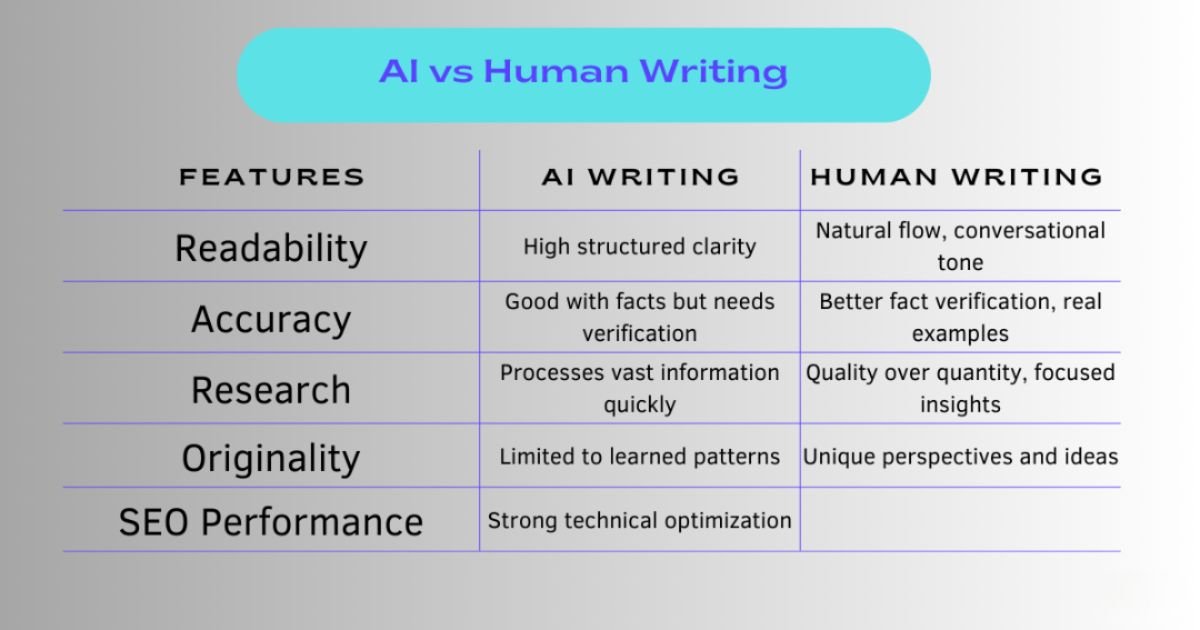
I put this together based on what I’ve personally noticed across dozens of projects over the last two years, not as some abstract, theoretical list pulled from a research paper.
| Factor | Human Writers | AI Writers |
|---|---|---|
| Original opinions and experience | Strong, built over time through real work | Absent, or vague and generic |
| Writing speed | Slower, more deliberate | Very fast, near-instant |
| Cost per piece | Higher, reflects skill and time | Lower, often dramatically so |
| Emotional connection with readers | Strong, when done well | Weak, even with good prompting |
| Help with SEO structure | Manual, takes real effort and testing | Good, especially with detailed prompting |
| Factual accuracy | Verifiable, writer is accountable | Needs constant fact-checking |
| Brand voice consistency | Strong, especially with practice | Inconsistent without heavy human editing |
| Ability to interview real sources | Yes | No |
| Risk of sounding generic or “AI-written” | Low, with an experienced writer | High, unless heavily reworked |
| Long-term reader trust and loyalty | Builds over time | Doesn’t really build at all |
What this table tells me is fairly simple once you sit with it: AI wins on speed and cost, no contest there. Humans still win on basically everything that actually makes content worth a reader’s time.
Real Examples From My Own Work
A while back, I was given two fairly similar assignments for the same client in the same week. One was a straightforward how-to guide, the kind of thing that’s already been written a hundred times across the internet. The other was an opinion piece about a controversial shift happening in our industry at the time.
For the how-to guide, I leaned on AI heavily for the outline and the first rough draft, then edited it down to something cleaner and more useful. It took me roughly half the time it normally would have, and the client was genuinely happy with the result. Honestly, a reader probably couldn’t tell much of a difference, because that kind of practical, instructional content doesn’t really need a strong personal voice to do its job well.
The opinion piece was a completely different story. I tried starting with AI for that one too, just to see what would happen out of curiosity. The draft it gave me back was balanced, safe, and almost completely lifeless. It carefully avoided taking any real position, the way a press release avoids saying anything specific. I ended up scrapping nearly all of it and writing the piece from scratch instead, pulling from a genuinely frustrating client experience I’d actually lived through myself that same year.
That piece ended up getting more engagement, more direct replies, and more shares than almost anything else I wrote that entire quarter. That contrast, sitting side by side in the same week, taught me more about this debate than any think-piece ever could. AI is a genuinely useful assistant for content that doesn’t need a soul behind it. It’s a poor, often obvious substitute for content that does.
How Writers Can Stay Relevant in the AI Era
Based on everything I’ve personally gone through over the last couple of years, here’s what’s actually working right now, not just for me, but for other writers I know who are doing genuinely fine despite all the noise:
- Build a real point of view — Don’t just summarize information that’s already floating around the internet. Take an actual position, even an unpopular one sometimes, and be willing to back it up with reasoning.
- Specialize in niches AI genuinely struggles with — Personal essays, investigative pieces, and niche technical writing where deep accuracy and real nuance matter a great deal.
- Use AI as a tool, not a ghostwriter — Let it help with structure, speed, and the boring first pass, but don’t let it write your actual conclusions, opinions, or stories for you.
- Lean into storytelling and original research — Interviews, case studies, and genuine first-hand accounts are things AI simply cannot fabricate convincingly, no matter how good the prompt is.
- Build visible, recognizable authority — A byline with real credibility, consistent publishing over time, and a name readers actually recognize carries weight AI-generated content will likely never have on its own.
- Get comfortable being wrong sometimes — A confident, specific opinion that might be a little controversial will almost always outperform a perfectly balanced, forgettable summary.
The writers I see genuinely struggling right now aren’t struggling purely because of AI. In most cases, they’re struggling because they were already producing fairly replaceable content even before AI ever entered the picture. AI just made that underlying gap impossible to hide anymore.
What Google Itself Says About AI Content
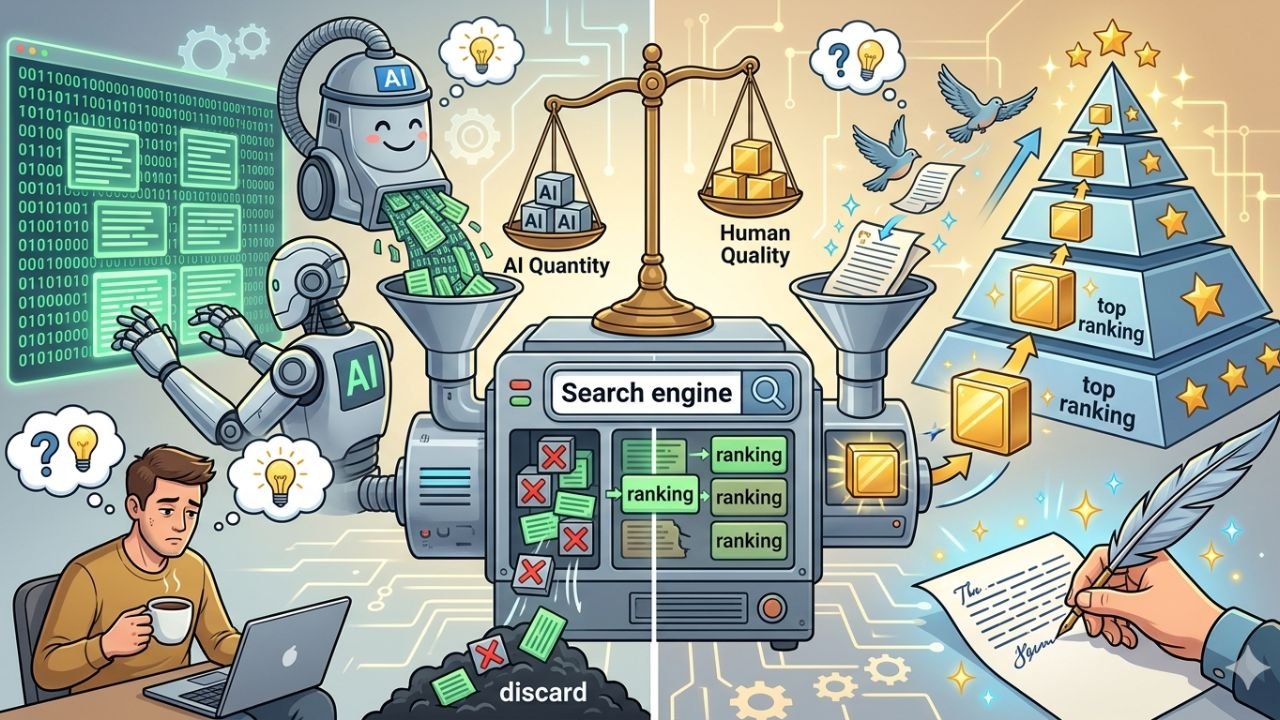
This part matters more than a lot of people seem to think. Google has been fairly clear that its focus is on whether content is genuinely helpful, original, and written with real expertise and experience behind it, not strictly on whether a human or a machine technically produced the words. In other words, Google isn’t trying to outright ban AI-assisted writing. It’s trying to penalize low-effort, unoriginal content, regardless of whether that content came from a human typing quickly or an AI tool generating at scale.
What this means practically, from what I’ve watched play out, is that thin AI-generated content with no real insight behind it is already losing visibility in search results. Meanwhile, content with genuine personal experience, the kind I’m sharing in this very article, tends to hold up noticeably better over time. That’s not really a loophole or a trick to exploit. It’s simply Google catching up to something readers have always wanted from content anyway, even before search algorithms cared about it explicitly.
So, Will AI Replace Writers? My Honest Verdict
After all this hands-on experience, here’s where I genuinely land on this question. Not the writers who bring something real to the page that couldn’t have come from anywhere else. AI is genuinely good at speeding up the mechanical, repetitive parts of writing, and I’d be lying if I said it hasn’t made me faster, and in some specific ways, more organized at how I structure my own work.
But every single time I’ve tried to let it replace the actual thinking, the real opinions, the genuine stories, and the recognizable voice, it has fallen short. Not slightly short either. Noticeably, obviously short, in a way readers seem to pick up on instinctively, even when they can’t fully explain why a piece feels hollow.
So if you’re a writer right now genuinely wondering whether your job is quietly disappearing, my honest take is this: the version of writing that’s disappearing is the kind that never really needed a human behind it in the first place. The kind of writing that requires actual lived experience, sound judgment, and a real voice isn’t going anywhere meaningful. If anything, from everything I’ve personally watched happen, it’s becoming more valuable, simply because it’s getting rarer in a sea of content that all starts to sound the same.
Frequently Asked Questions
Q1. Will AI replace writers in 2026?
Not entirely, based on everything I’ve personally experienced so far. AI is replacing low-effort, generic writing tasks at a fast pace, but writers who bring original opinions, real experience, and a strong, consistent voice to their work are still very much in demand, and that demand has arguably grown as generic AI content has flooded so much of the internet.
Q2. Can AI write better than humans?
In terms of raw speed and grammatical correctness, often yes, honestly. In terms of original thought, genuine emotional connection, and lived experience, no, not in my experience at least. AI can mimic structure and tone convincingly, but it can’t replicate insight it never actually had to begin with.
Q3. Will AI replace content writers completely?
Based on what I’ve personally seen play out, this seems unlikely. It’s mainly replacing content writers who only ever produced generic, formulaic content with no real personality behind it. Writers who consistently add real research, genuine opinion, and personality to their work remain essential, often more so now than before AI tools became widely available.
Q4. What writing jobs are safest from AI right now?
From what I’ve observed, roles that rely heavily on original research, direct interviews, strong personal opinion, investigative work, and deep niche expertise tend to be the safest, mainly because AI has no real lived experience or genuine access to fabricate convincingly in those specific areas.
Q5. Should writers learn to use AI tools?
Yes, honestly, and I say that as someone who was initially pretty skeptical. Avoiding AI entirely right now mostly just means working slower than writers who’ve already learned to use it well. The actual goal isn’t to compete with AI on raw speed. It’s to use it for the boring, repetitive parts so you have more time and energy left for the parts only you can genuinely do well.
Final Thoughts
I didn’t write this to convince you AI is completely harmless, and I didn’t write it to convince you it’s some unstoppable replacement for writers either. I wrote it because I’ve actually lived through this shift personally, day after day, draft after draft, project after project, and the real picture is a lot less dramatic, and honestly a lot more interesting, than most headlines on this topic suggest.
AI changed how I work in some meaningful ways. It hasn’t changed why I write, and from everything I’ve seen so far, it hasn’t replaced the writers willing to actually show up with something real to say either. If you’re a writer reading this and wondering exactly where you fit into all of this right now, I’d genuinely love to hear what your own experience with AI tools has looked like so far, because mine is clearly still just one perspective in a much bigger, still-unfolding conversation.
Also Read About: Is AI Content Bad for SEO? 7 Honest Truths You Need to Know in 2026