I still remember the first time I held an Android phone. It was 2010, a second-hand HTC Desire that a college friend passed on to me with a cracked screen protector and a half-charged battery. I didn’t care. The moment I unlocked it, I was hooked — the open ecosystem, the widgets, the ability to download apps outside a curated store. It felt rebellious. It felt free. That experience sent me down a rabbit hole that lasted years. I wanted to understand everything — not just how Android worked, but where it came from. Who built it? Who had the vision? And most importantly — who invented Android phone technology as we know it today?
This article is the result of years of reading, researching, and genuinely living through the Android era. Whether you’re a curious reader, a tech enthusiast, or someone writing a school project, this is the most comprehensive, honest, and experience-driven answer to the question: who invented Android phone?
The Short Answer: Andy Rubin and a Small Team of Visionaries
If you want the one-line answer: Andy Rubin is widely credited as the primary inventor of Android. But like all great inventions, the real story is far richer, more layered, and far more human than a single name suggests.
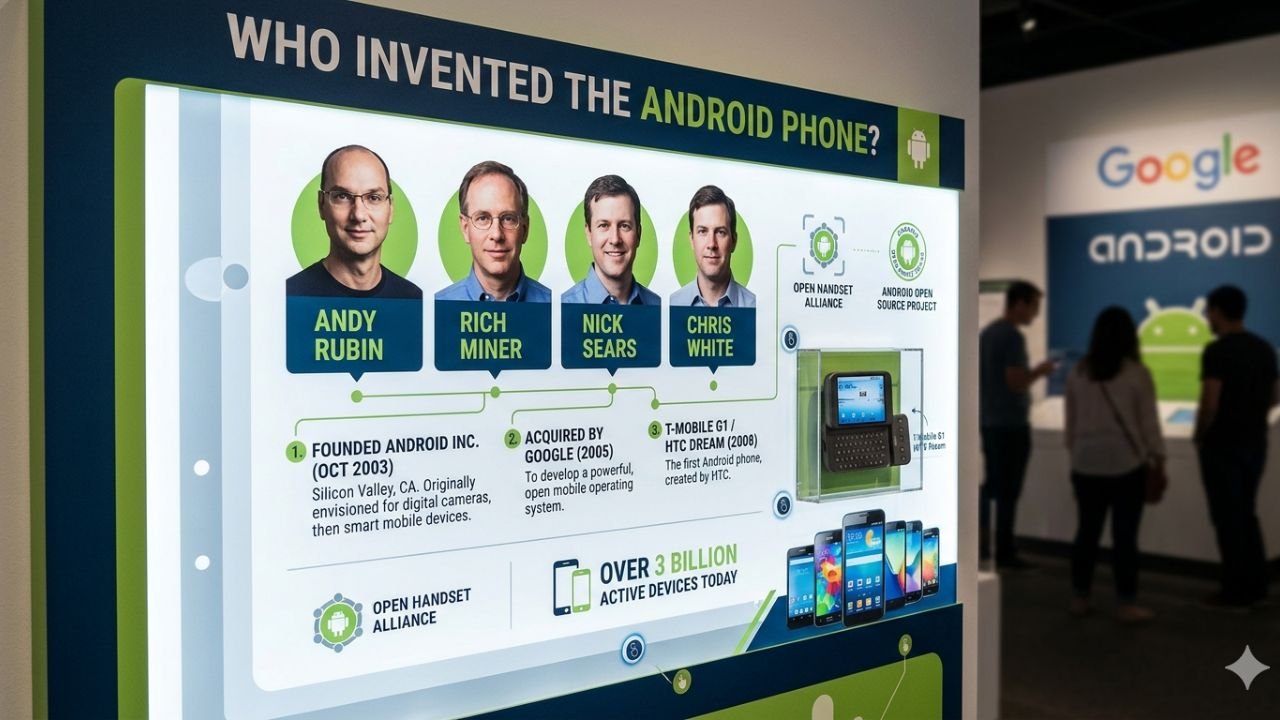
Andy Rubin co-founded Android Inc. in October 2003 alongside three other co-founders: Rich Miner, Nick Sears, and Chris White. Together, they built what would eventually become the most widely used mobile operating system on the planet.
But here’s what most quick-answer articles don’t tell you: Android wasn’t originally intended to be a smartphone OS at all.
Before Android — The World of Early Mobile Phones
To truly understand who invented Android phone software and why it mattered, you have to go back to what mobile phones looked like before 2003.
What Mobile Phones Looked Like Before Android
I remember this era vividly. Before Android, the mobile landscape was:
- Nokia-dominated — Symbian OS ruled the market, and phones were built primarily for calling and SMS
- BlackBerry territory — enterprise users typed emails on physical QWERTY keyboards, and it felt cutting-edge
- Windows Mobile — Microsoft had a mobile OS, but it felt like a shrunken desktop crammed onto a small screen
- Feature phones — the majority of the world used phones with preset, locked-down menus and zero customization
There was no app ecosystem in the modern sense. No seamless internet. No intuitive touchscreen interface for the masses. The smartphone revolution hadn’t happened yet.
The Problem Rubin Wanted to Solve
Andy Rubin, who had previously worked at Apple and founded a company called Danger (makers of the Sidekick), saw the fragmentation and frustration in mobile software. His insight was powerful: what if there was a free, open-source operating system that any hardware manufacturer could use?
This is the philosophical DNA of Android — openness, flexibility, and accessibility. And it all started in a small office in Palo Alto, California.
The Founding of Android Inc. — 2003
October 2003: The Birth of an Idea
In October 2003, Andy Rubin, Rich Miner, Nick Sears, and Chris White officially founded Android Inc. The company was secretive from the start. Very few people outside the founding team knew what they were building.
Here’s what each founder brought to the table:
| Co-Founder | Background | Role in Android |
|---|---|---|
| Andy Rubin | Apple, Danger Inc. | CEO, primary visionary, OS architecture |
| Rich Miner | Wildfire Communications | Mobile strategy, business development |
| Nick Sears | T-Mobile USA | Carrier relationships, industry expertise |
| Chris White | WebTV, Motorola | Software engineering, UI development |
The original concept wasn’t a phone OS — it was an operating system for digital cameras. The idea was to create a smarter camera platform that could sync with the internet. However, when the team evaluated the market size, they pivoted — and that pivot changed the world.
The Pivot to Smartphones
By early 2004, the founders recognized that the opportunity in smartphones was far larger than digital cameras. Mobile internet was beginning to grow. People were starting to want more from their phones. The team quietly shifted their focus to building a mobile operating system.
They worked in stealth mode, scraping for funding. Rubin famously had to borrow money at one point just to keep the lights on. The early days of Android were defined by passion, not paychecks.
Google Steps In — The 2005 Acquisition
Why Google Bought Android
In August 2005, Google acquired Android Inc. for an estimated $50 million — a figure that today looks like the greatest bargain in tech history.
I’ve read several accounts of how this deal came together, and every version points back to one person: Larry Page, Google’s co-founder. Page understood that the future of the internet wasn’t on desktops. It was in people’s pockets. Controlling a mobile OS meant controlling the mobile internet gateway — and for a company whose business was built on internet search and advertising, that was everything.
Google kept the acquisition quiet. The Android team stayed intact, with Rubin leading the project internally. Most people in the tech industry had no idea what Google was building.
Google’s Strategic Vision
Here’s what made Google’s acquisition brilliant — they didn’t just buy Android to have a phone. They made it free and open-source through the Android Open Source Project (AOSP). Any manufacturer could use Android without paying licensing fees. This was a direct contrast to Microsoft’s Windows Mobile, which required licensing payments.
The result? Every major manufacturer — Samsung, HTC, LG, Motorola, Sony — could build Android phones without the overhead. The ecosystem exploded.
The First Android Phone — A Historic Moment
The HTC Dream (T-Mobile G1) — October 2008
The first commercially available Android phone was the HTC Dream, released on October 22, 2008, in the United States under the T-Mobile G1 branding.
I’ve seen this phone in museums and tech throwback videos, and it’s remarkable how much DNA of modern Android you can spot in that chunky slider device. It had:
- A physical QWERTY keyboard that slid out from under the screen
- A 3.2-inch touchscreen (tiny by today’s standards)
- Android 1.0 — the very first public version
- Google Maps, Gmail, and YouTube pre-installed
- An app marketplace (then called Android Market, now Google Play)
The phone wasn’t beautiful. The software was rough. But the foundation was revolutionary.
What Made Android 1.0 Special
| Feature | Android 1.0 (2008) | Competitors at the Time |
|---|---|---|
| App Marketplace | ✅ Android Market | ✅ Apple App Store (launched July 2008) |
| Google Maps Integration | ✅ Built-in | ❌ Limited or absent |
| Open Source | ✅ Yes (AOSP) | ❌ Proprietary |
| Manufacturer Licensing Cost | ✅ Free | 💰 Paid (Windows Mobile) |
| Customizable Home Screen | ✅ Yes | ❌ Limited |
| Third-Party App Support | ✅ Yes | ⚠️ Limited |
Who Is the Android Owner Today?
This is a question I get asked surprisingly often, especially by people who are newer to the tech world. So let me answer it clearly.
The android owner in terms of corporate ownership is Google LLC, which is itself a subsidiary of Alphabet Inc. Google has owned Android since the 2005 acquisition and has developed it continuously ever since.
However, the ownership story is layered:
- Google owns the Android brand, the core OS, and the Play Store
- AOSP (Android Open Source Project) is the open-source version that anyone can use and modify
- Device manufacturers (Samsung, Xiaomi, OnePlus, etc.) build on top of AOSP and add their own UI layers (Samsung’s One UI, Xiaomi’s MIUI, etc.)
- Andy Rubin sold his stake and interest when Google acquired Android Inc. — he has not been involved in Android development since departing Google in 2014
The most accurate answer is: Google owns Android, but the open-source nature of AOSP means no single company “owns” all of Android’s derivatives.
Andy Rubin — The Man Behind the Invention
Personal Reflections on Rubin’s Story
Every time I read about Andy Rubin, I’m struck by how unconventional his journey was. He didn’t follow a straight line. He worked at Apple. Andy founded a company that made a cult-favorite teen device (the Sidekick). He nearly ran out of money building Android. And then he sold it to Google for $50 million before watching it become worth hundreds of billions.
Andy Rubin’s Timeline
| Year | Event |
|---|---|
| 1963 | Andy Rubin born in New Bedford, Massachusetts |
| 1989 | Joined Apple as a manufacturing engineer |
| 1999 | Co-founded Danger Inc. (makers of the T-Mobile Sidekick) |
| 2003 | Co-founded Android Inc. |
| 2005 | Android Inc. acquired by Google for ~$50 million |
| 2007 | Led the Open Handset Alliance announcement |
| 2008 | Android 1.0 launched on HTC Dream/T-Mobile G1 |
| 2013 | Stepped down as head of Android at Google |
| 2014 | Left Google entirely |
| 2015 | Founded Essential Products (a hardware startup) |
What Made Rubin’s Vision Different
In interviews and profiles I’ve read over the years, Rubin consistently returned to one theme: openness. He believed that proprietary, closed systems were bad for consumers and bad for innovation. His vision was that a truly open mobile OS would allow competition, creativity, and ultimately better products for everyone.
That philosophy is why Android today powers over 3 billion active devices globally — from flagship Samsung Galaxy phones to budget devices in rural India and Sub-Saharan Africa.
The Co-Founders — Often Forgotten Heroes
Most people can name Andy Rubin when asked who invented Android phone. Far fewer can name his co-founders. That always felt unfair to me, so here’s their proper recognition:
Rich Miner
Rich Miner came from the wireless industry, having previously run a company called Wildfire Communications. His expertise in mobile carrier relationships was instrumental in getting early Android partnerships off the ground. He’s often called the “quiet co-founder” — less public-facing than Rubin but deeply important to Android’s early business strategy.
After the Google acquisition, Miner became a venture partner at Google Ventures, where he focused on mobile and health tech investments.
Nick Sears
Nick Sears brought T-Mobile experience to the team. His understanding of how carriers operated — their requirements, their concerns, their business models — was invaluable when Android needed to convince carriers to adopt the platform. Without carrier buy-in, even the best mobile OS dies before launch.
Chris White
Chris White’s background in WebTV and Motorola brought deep software engineering expertise to the team. He was central to building the earliest versions of what would become Android’s UI and core software architecture.
The Open Handset Alliance — Building an Ecosystem
November 2007: The Industry Partnership That Accelerated Everything
On November 5, 2007 — almost exactly two years before the HTC Dream launched — Google announced the Open Handset Alliance (OHA), a consortium of 84 companies committed to building open standards for mobile devices.
The founding members included:
- HTC — hardware manufacturing
- Motorola — devices and chipsets
- Samsung — hardware manufacturing
- LG — device manufacturing
- Qualcomm — mobile chipsets
- Texas Instruments — semiconductors
- T-Mobile — US carrier partner
- Sprint Nextel — US carrier partner
- Intel — processor technology
- Google — OS and platform
This alliance was Rubin’s masterstroke. Instead of Android fighting every hardware company and carrier one by one, the OHA created a united front. It signaled to the market that Android wasn’t a solo Google experiment — it was an industry movement.
How Android Evolved Over the Years
One of my favorite personal tech rituals has been following Android version releases. Each version marked a distinct era in mobile history:
| Android Version | Name | Year | Key Feature Introduced |
|---|---|---|---|
| 1.0 | (No name) | 2008 | App Market, Google Maps, Gmail |
| 1.5 | Cupcake | 2009 | On-screen keyboard, video recording |
| 2.0 | Eclair | 2009 | Multi-touch, Google Maps Navigation |
| 2.3 | Gingerbread | 2010 | NFC support, improved battery management |
| 3.0 | Honeycomb | 2011 | Tablet-optimized UI |
| 4.0 | Ice Cream Sandwich | 2011 | Unified phone/tablet OS, face unlock |
| 4.1 | Jelly Bean | 2012 | Google Now, smoother UI (Project Butter) |
| 5.0 | Lollipop | 2014 | Material Design, ART runtime |
| 6.0 | Marshmallow | 2015 | App permissions, Doze battery mode |
| 7.0 | Nougat | 2016 | Multi-window, improved notifications |
| 8.0 | Oreo | 2017 | Picture-in-picture, notification channels |
| 9.0 | Pie | 2018 | Gesture navigation, adaptive battery |
| 10 | Android 10 | 2019 | Dark mode, privacy controls |
| 12 | Android 12 | 2021 | Material You design overhaul |
| 14 | Android 14 | 2023 | AI integration, satellite connectivity |
| 15 | Android 15 | 2024 | Advanced AI features, health tracking APIs |
Part 10: Android vs. iOS — The Rivalry That Defined an Era
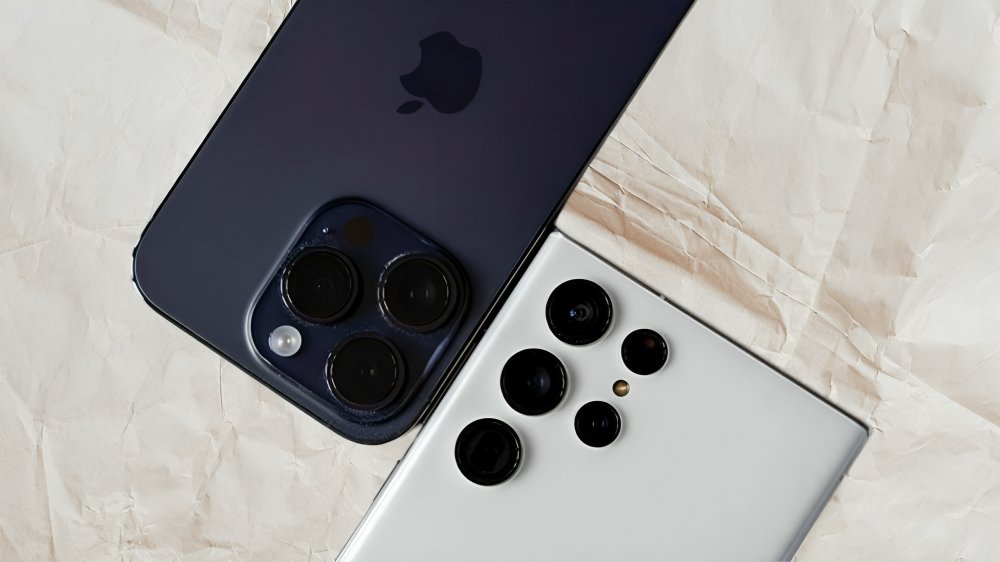
No deep dive into Android history would be complete without addressing the Apple rivalry. I’ve used both platforms extensively, and here’s my honest comparison:
The Steve Jobs vs. Andy Rubin Angle
Steve Jobs was famously furious when Android launched. He called it a “stolen product” and vowed to wage “thermonuclear war” on Android. This quote became one of the most famous in tech history.
The reality is more nuanced. Both iOS and Android were building on the same wave of technology — multi-touch screens, mobile internet, app ecosystems. They were responses to the same market opportunity, developed in parallel.
Android vs. iOS: Feature Comparison
| Feature | Android | iOS |
|---|---|---|
| Open Source | ✅ Yes (AOSP) | ❌ No (Proprietary) |
| Customization | ✅ Extensive | ❌ Limited |
| App Store | Google Play Store | Apple App Store |
| Hardware Choice | ✅ Many manufacturers | ❌ Apple only |
| Price Range | Budget to premium | Premium only |
| Market Share (2025) | ~72% global | ~27% global |
| Security Updates | Varies by manufacturer | ✅ Consistent |
| Integration with Google Services | ✅ Deep native | ⚠️ Via apps |
Android won the global market share battle decisively — largely because of its open licensing model that allowed affordable devices to reach emerging markets.
Android’s Impact on the World — My Personal Take
I’ve thought about this a lot. This question is really a question about who helped democratize the internet. Here’s what Android has genuinely changed in the world:
Democratization of the Internet
Before Android (and cheap Android phones), internet access was largely the privilege of desktop users in developed countries. Today, hundreds of millions of people in India, Africa, Southeast Asia, and Latin America access the internet primarily through affordable Android smartphones.
The App Economy
Android helped create a multi-trillion-dollar app economy. From Instagram to Uber to WhatsApp — the mobile app industry exists in its current form because of the Android ecosystem.
Innovation Through Competition
Because Android was free and open-source, hardware manufacturers competed furiously on price, specs, and design. This competition drove incredible innovation — cameras got better, screens got sharper, batteries got smarter — at speeds that a monopoly market never could have achieved.
Emerging Market Connectivity
This is the impact I find most meaningful. Companies like Google (with Android Go), Xiaomi, and Transsion built ultra-affordable Android phones specifically for emerging markets. The result: a first-generation internet user in rural Nigeria or rural Bihar can now access banking apps, education platforms, and health information — all because of the open OS Andy Rubin envisioned in 2003.
Frequently Asked Questions About Who Invented Android Phone
Q1: Who invented Android phone — was it Google or Andy Rubin?
Andy Rubin invented Android in 2003 alongside co-founders Rich Miner, Nick Sears, and Chris White. Google acquired Android Inc. in 2005 and has developed it ever since. Both answers are correct depending on context.
Q2: Did Steve Jobs invent Android?
No. Steve Jobs invented iOS, the operating system that powers iPhones. Android and iOS are competing platforms developed by different teams with different philosophies.
Q3: When was the first Android phone released?
The first commercial Android phone was the HTC Dream (T-Mobile G1), released on October 22, 2008.
Q4: Who owns Android today?
Google LLC, a subsidiary of Alphabet Inc., officially holds ownership of Android. Google has owned Android since August 2005.
Q5: Is Android still open source?
Yes. Android Open Source Project (AOSP) remains publicly available. However, Google’s core apps (Gmail, Maps, Play Store) are not open source.
Q6: How many people use Android today?
As of 2025, Android powers over 3 billion active devices worldwide, making it the most widely used mobile operating system in history.
Q7: What happened to Andy Rubin after Android?
Rubin left Google in 2014, founded Essential Products in 2015 (which shut down in 2020), and has largely stepped back from the public tech spotlight.
Lessons From the Android Story
Reflecting on everything I know about the history of Android — from its scrappy Palo Alto startup origins to powering 3 billion devices — several lessons stand out:
1. The Power of Open Ecosystems
Android succeeded not because it was the best mobile OS at launch (it wasn’t), but because its openness created an ecosystem of innovation that no proprietary system could match.
2. Timing and Pivoting Matter
Rubin’s original idea (a camera OS) wasn’t wrong — it was just too small. Recognizing a bigger opportunity and pivoting swiftly is one of the defining moves in Android’s founding story.
3. The Acquisition That Changed Everything
Google’s $50 million bet in 2005 looks like genius in retrospect. Android has generated hundreds of billions in revenue for Google through the Play Store and mobile advertising. Strategic acquisitions of small, focused teams can yield generational returns.
4. Platform Beats Product
Andy Rubin didn’t build one phone. He built a platform that millions of manufacturers, developers, and designers could build on. That multiplier effect is what created one of history’s greatest technology success stories.
Conclusion: The Answer Is Bigger Than One Name
So — who invented Android phone technology? The full answer is: Andy Rubin, alongside co-founders Rich Miner, Nick Sears, and Chris White, founded Android Inc. in 2003 and built the foundation of what Android is today. Google then acquired the company in 2005, invested massively in its development, and launched it to the public in 2008 through a partnership with HTC and T-Mobile.
The android owner today — in corporate terms — is Google / Alphabet Inc. But the spiritual owner of Android’s philosophy is the idea of openness itself: the belief that great technology should be accessible to everyone, everywhere, regardless of budget or geography.
That’s the story that changed my relationship with technology forever — from the moment I held that cracked HTC Desire in 2010 to the sleek, AI-powered Android device I use today. It’s not just a software story. It’s a story about vision, timing, partnerships, and the belief that the mobile internet should belong to the world.
And it all started with one question — the same one you probably Googled to find this article.
Also Read About: iPhone vs Android: Which Smartphone Is Better in 2026?